How Should a Bodywarmer Fit? A Complete Sizing Guide
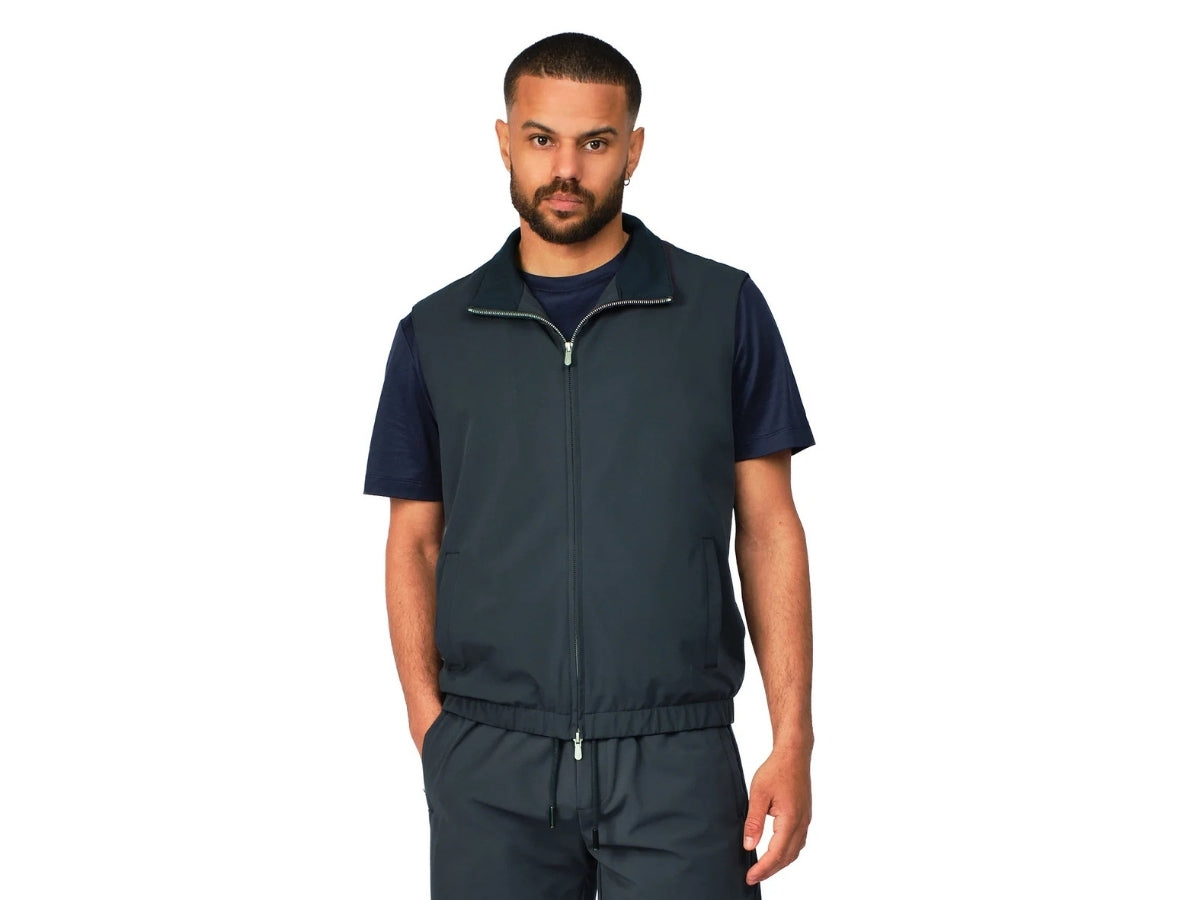
A bodywarmer should sit close to your body without pulling, with the shoulder seam landing directly on your shoulder bone and enough room underneath for one mid layer, usually a shirt and a fine knit. The hem should finish at the top of your hip, and the armholes should sit high enough that the garment stays put when you raise your arms.
Get the shoulder seam and the armhole right and the rest follows. Those are also the only two things you cannot fix after buying.
What is a bodywarmer supposed to do?
A bodywarmer insulates your core and leaves your arms free. That single job explains every fit rule below.
Because it has no sleeves, it works as a layer inside an outfit rather than as a standalone jacket. It is built to go over a shirt or a knit, and in colder weather to sit under a coat. A bodywarmer that only fits over a T shirt is one you will wear for three weeks a year and then forget about.
How should a bodywarmer fit across the shoulders?
The shoulder seam should sit on the outer edge of your shoulder bone. Not on your upper arm, and not inside your shoulder line.
This is the checkpoint that matters most, and it is the easiest one to see. A seam that has dropped onto the arm makes the whole piece read as oversized and creates bunching around the armhole. A seam sitting too far inward restricts you across the back and pulls the moment you reach forward.
Shoulders cannot be altered on a bodywarmer without rebuilding the garment. If the shoulders are wrong, the size is wrong. Nothing else you like about the fit will make up for it.
Should a bodywarmer be tight or loose?
Neither. It should be close, with structure.
Here is the test. Wearing a shirt and a fine knit underneath, you should be able to slide a flat hand between the bodywarmer and your chest, but not a closed fist. Zipped up, the front should lie flat with no horizontal pull lines across the chest or stomach.
There is a practical reason to avoid going too tight. Insulation only works when it has loft, meaning trapped air inside the fill. Compress it against your body and you lose a measurable amount of the warmth you paid for. Too loose has the opposite problem, with warm air escaping at the sides every time you move.
How much room do you need for layering?
Size for one mid layer, not two.
| Layer underneath | What to do |
|---|---|
| T shirt only | Your normal size will feel roomy |
| Shirt | Normal size |
| Shirt and a fine knit | Normal size, this is what the cut is designed around |
| Chunky knit or hoodie | Consider sizing up |
Most bodywarmers already have layering room built into the pattern. Sizing up to be safe is the most common mistake people make, because it drops the shoulder seam and lengthens the armhole at the same time. The result looks borrowed rather than relaxed.
If you mainly layer over knitwear, check the weight of the knit rather than the category. A fine merino adds almost nothing. A heavy cable knit adds enough to change your size.
How long should a bodywarmer be?
The hem should finish at the top of your hip bone, roughly level with the pocket opening on your trousers.
Shorter than that and your lower back is exposed when you bend or sit down. Longer than that and it starts reading as a sleeveless jacket, which cuts your leg line and makes you look shorter than you are. A slightly longer back panel is normal and intentional, giving you coverage while seated without adding bulk at the front.
How should the armholes sit?
High and clean. The armhole should sit close under your arm without touching it, and the edge should lie flat against your shirt rather than standing away from it.
Test it by raising both arms above your head. The bodywarmer should stay where it is. If the whole garment lifts with your arms, the armhole is cut too low for you, which nearly always means the body is too big as well.
Low armholes are why some bodywarmers feel restrictive even though they look roomy. The extra fabric under the arm has nowhere to go, so it bunches and catches every time you move.
Should you size up in a bodywarmer?
Only in two situations. If you regularly layer over a chunky knit or a hoodie, or if the shoulder measurement in your normal size is genuinely tight across the back.
Otherwise take your normal size. If you fall between sizes, size down rather than up. A bodywarmer that is slightly close reads as deliberate. One that is slightly large reads as a mistake, and no amount of styling hides a dropped shoulder seam.
What if your shoulders and chest are different sizes?
This is the most common real world fit problem, and it is worth saying plainly: most men are not a single clean size. Broad shoulders with a slimmer waist, or a fuller chest with narrower shoulders, both make the standard advice harder to apply.
The rule is to fit the shoulders first and accept some compromise elsewhere. Shoulders cannot be altered. Everything else can be worked around.
If your shoulders are broad relative to your chest, take the size that puts the seam in the right place even if the body feels slightly roomy. A little extra room through the waist reads as normal on a bodywarmer, because the garment is meant to sit over layers anyway.
If your chest is fuller than your shoulders, look for a bodywarmer with some stretch in the fabric or a panelled front rather than sizing up. A nylon and spandex construction gives you a few centimetres of give across the chest without changing the shoulder measurement, which is exactly what you need here.
The one thing not to do is size up to solve a chest problem. You will fix the chest and break the shoulders, and the shoulders are the part people notice.
Can you wear a bodywarmer under a coat?
Yes, and in a Dutch autumn it is one of the most useful things you can do with one. The key is choosing a lower loft, slimmer bodywarmer for this, so it adds warmth without adding bulk across the shoulders and chest inside your jacket.
If you are still deciding which style suits your climate and daily routine, we broke that down separately in our guide to the best bodywarmers for the Dutch climate.
How to tell your bodywarmer does not fit
Five checks, in order of how much they matter:
- The shoulder seam is off your shoulder bone. Wrong size, and there is no fix.
- The whole garment lifts when you raise your arms. The armhole is cut too low for you.
- Horizontal pull lines across the chest when zipped. Too small.
- Gaping at the armhole or along the side. Too large, and warm air is escaping.
- The hem sits below your hip bone. Too long, and it is shortening your proportions.
Quick reference
- Shoulder seam on the shoulder bone
- Flat hand fits between chest and garment, closed fist does not
- Hem at the top of the hip
- Armhole high and flat, garment stays put when you raise your arms
- Size for one mid layer, and size down rather than up when you are in between