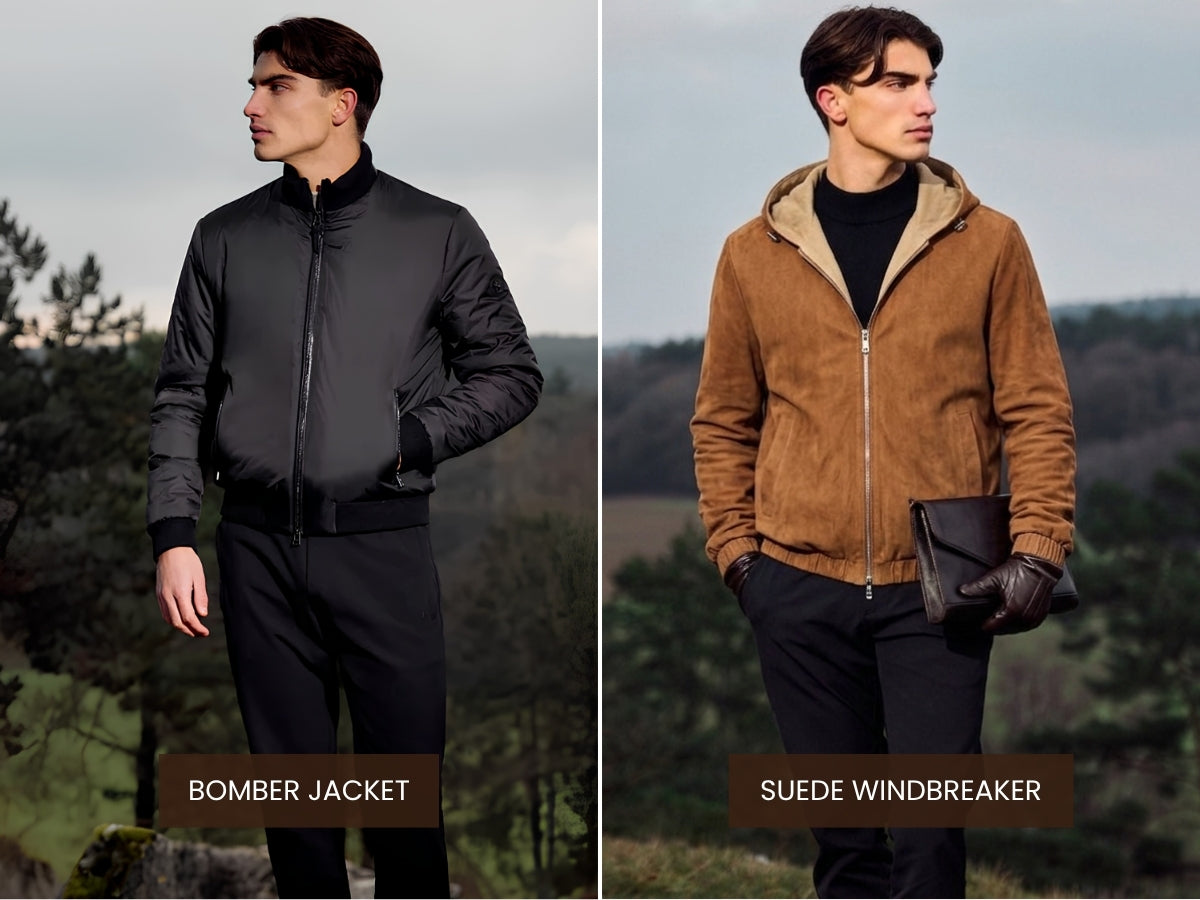
Bomber vs coupe-vent : quelle différence ?
Ce sont tous deux des incontournables d’Outerwear léger. Tous deux se ferment par zip. Tous deux conviennent à une tenue casual. Mais faites le mauvais choix et vous risquez d’avoir trop froid, de vous sentir trop contraint ou simplement de manquer de justesse. Le débat Bomber ou coupe-vent fait partie des questions les plus fréquentes lorsqu’un homme construit sa rotation de vestes, et la réponse compte plus qu’on ne le pense.
Ce guide explique précisément ce qui distingue les deux modèles, les situations où chacun excelle, et comment choisir celui qui mérite sa place dans votre vestiaire.
Qu’est-ce qu’un Bomber ?
Un Bomber est une veste courte, longueur taille, à la silhouette Boxy, avec des poignets élastiqués côtelés, une base côtelée et un zip frontal intégral. Les finitions côtelées sont le signe distinctif. Ce sont elles qui différencient immédiatement un Bomber de toute autre veste courte sur le marché.
Conçu à l’origine pour les pilotes militaires pendant la Première Guerre mondiale, puis affiné avec l’iconique MA-1 de 1958, le Bomber s’est imposé dans le vestiaire du quotidien sans perdre son identité. Structuré, légèrement isolant selon les versions, il porte une esthétique assurée, marquée par l’Heritage. Si vous souhaitez approfondir ses origines et comprendre pourquoi cette veste traverse près de 110 ans d’histoire, notre guide complet qu’est-ce qu’un Bomber retrace toute son histoire.
Les caractéristiques clés en un coup d’œil :
-
Coupe Cropped, longueur taille
-
Poignets, base et col côtelés
-
Coupe Boxy, esprit blouson
-
Présente généralement plus de structure et de poids qu’un coupe-vent
-
Confectionné en nylon, cuir, daim, satin ou tissus techniques
Qu’est-ce qu’un coupe-vent ?
Un coupe-vent est une veste fine et légère, conçue avant tout pour bloquer le vent et résister à une pluie légère. Il n’est pas pensé pour tenir chaud. Il sert de barrière entre votre corps et les éléments, sans ajouter de volume ni de poids.
Là où le Bomber offre de la structure, le coupe-vent privilégie la mobilité. Là où le Bomber se distingue par ses finitions côtelées, le coupe-vent adopte des poignets élastiqués et une fermeture simple, zippée ou à cordon. Il est généralement confectionné en nylon ou en polyester au tissage serré, même si les versions premium en daim ou en mélanges raffinés le rapprochent d’un vestiaire quotidien plus habillé.
Pour une analyse complète du coupe-vent, de ses matières, du moment où le porter et de la façon de le styliser, notre guide détaillé qu’est-ce qu’un coupe-vent réunit tout ce qu’il vous faut.
Les caractéristiques clés en un coup d’œil :
-
Léger et compact
-
Résistant au vent et respirant
-
Poignets et ourlet élastiqués (sans bord-côte)
-
Structure minimale, pensée pour le mouvement
-
Comprend souvent une capuche
Bomber vs Windbreaker : les différences clés
Comprendre la différence entre Windbreaker et Bomber repose sur cinq points essentiels :
1. Structure et poids
Le Bomber l’emporte ici. Il est plus lourd, plus structuré et garde sa forme sur le corps. Un Windbreaker s’aplatit presque entièrement, idéal dans votre sac, moins flatteur sur votre silhouette. Si vous recherchez une veste qui structure le haut du corps et dessine une silhouette nette, le Bomber est le choix évident.
2. Chaleur et isolation
Les Bombers sont plus chauds. La plupart comportent une forme de doublure, qu’il s’agisse d’un intérieur matelassé, d’une couche intérieure brossée ou, dans les styles vintage, d’un col complet en shearling. Les Windbreakers offrent peu ou pas d’isolation. Leur rôle est de protéger du vent, pas de retenir la chaleur. Sous 10 °C, un Windbreaker seul ne suffit pas.
3. Performance face aux intempéries
C’est là que le Windbreaker prend l’avantage. Il est conçu pour faire face au vent et à une pluie légère grâce à des tissus respirants au tissage serré, qu’un Bomber ne peut tout simplement pas égaler. Si vous êtes surpris par une bruine, un Windbreaker la repousse. La plupart des Bombers absorberont plutôt l’humidité.
4. Compacité et mobilité
Les Windbreakers se plient facilement et pèsent presque rien. Pour voyager, faire de l’exercice ou toute situation où vous avez besoin d’une couche à glisser dans un sac, le Windbreaker est le choix pratique. Un Bomber se transporte moins facilement et ajoute plus de poids à vos affaires.
5. Style et polyvalence
Les deux sont polyvalents, mais différemment. Un Bomber fonctionne aussi bien dans des looks smart casual que streetwear. Il offre assez de structure pour s’associer à des chinos, des pantalons Tailored ou du Denim brut. Un Windbreaker reste par nature plus casual et sportif, même si des matières premium comme le daim peuvent l’amener vers un registre plus habillé. Pour les associer au reste de votre vestiaire, notre guide des vestes pour homme présente les grands styles d’outerwear et le moment juste pour les porter.
Comparatif rapide : Bomber vs Windbreaker
|
Caractéristique |
Veste Bomber |
Coupe-vent |
|
Poids |
Moyen à lourd |
Très léger |
|
Chaleur |
Modérée |
Minimal |
|
Protection contre le vent |
Faible à modérée |
Élevée |
|
Résistance à la pluie |
Faible |
Modérée |
|
Compacité |
Faible |
Élevée |
|
Structure |
Oui |
Minimal |
|
Capuche |
Rarement |
Généralement |
|
Idéal pour |
Style du quotidien, temps frais |
Usage actif, voyage, layering |
Quand choisir un Bomber
Un Bomber est le bon choix lorsque :
-
Vous voulez une veste qui garde sa forme et apporte de la structure à votre tenue
-
Vous vous habillez pour un temps frais, environ 5 °C à 15 °C, sans prévoir de superpositions épaisses dessous
-
Votre tenue penche vers le smart casual, Chino, pantalon Tailored, denim épuré
-
Vous voulez une pièce durable, avec une identité visuelle forte
-
Vous n’attendez ni vent ni pluie, mais avez simplement besoin d’une couche entre deux saisons
Le Bomber fonctionne surtout comme point d’ancrage stylistique. C’est la veste que vous choisissez lorsque vous voulez une allure soignée sans en faire trop.
Quand choisir un coupe-vent
Un coupe-vent est le bon choix lorsque :
-
Vous courez, faites du vélo, de la randonnée ou toute autre activité en extérieur
-
Vous avez besoin d’une couche compacte pour voyager ou vous déplacer
-
Le temps est doux mais venteux, ou sujet à des averses inattendues
-
Vous superposez une Hoodie ou une polaire et avez besoin d’une couche extérieure coupe-vent
-
Vous recherchez une veste casual, facile à porter pour les courses du quotidien
Le coupe-vent est votre veste utilitaire. Il n’affirme pas un style fort à lui seul, mais il fait son travail mieux que presque toute autre pièce lorsque les conditions deviennent imprévisibles.
Pouvez-vous porter les deux ?
Absolument, et la plupart des hommes dotés d’un vestiaire bien construit devraient posséder les deux. Ils remplissent des fonctions différentes, se portent dans des conditions différentes et se stylisent de façon suffisamment distincte pour éviter tout véritable doublon.
Voyez les choses ainsi : le Bomber est votre couche de style de référence lorsque le temps est frais et calme. Le coupe-vent est votre couche fonctionnelle de référence lorsque la météo est imprévisible ou lorsque vous êtes en mouvement. Ensemble, ils couvrent presque tous les besoins en Outerwear, hors plein hiver.
Verdict final
Comparer Bomber et coupe-vent ne revient pas vraiment à déterminer lequel est le meilleur. Il s’agit de savoir ce dont vous avez besoin. Si vous recherchez de la structure, du style et de la chaleur au quotidien, le Bomber s’impose. Si vous avez besoin d’une pièce compacte, résistante aux intempéries et pensée pour le mouvement, le coupe-vent est le choix le plus juste.
La différence entre un Bomber et un coupe-vent tient à leur fonction : l’un est une couche de style, l’autre une couche fonctionnelle. Idéalement, votre vestiaire compte les deux. Chez Pirloni, nous concevons ces deux styles avec la même exigence de matières de qualité et de coupes modernes, afin que chacun mérite sa place dans votre rotation.
FAQ's
Is a bomber jacket warmer than a windbreaker?
Can a windbreaker be worn like a bomber jacket?
Which is better for travel, a bomber or a windbreaker?
What's the main difference between a bomber and a windbreaker?
Can you wear a bomber jacket in the rain?
Dernière mise à jour: