Article: Men's Polo Shirt Guide: Fabrics, Fit and Styling
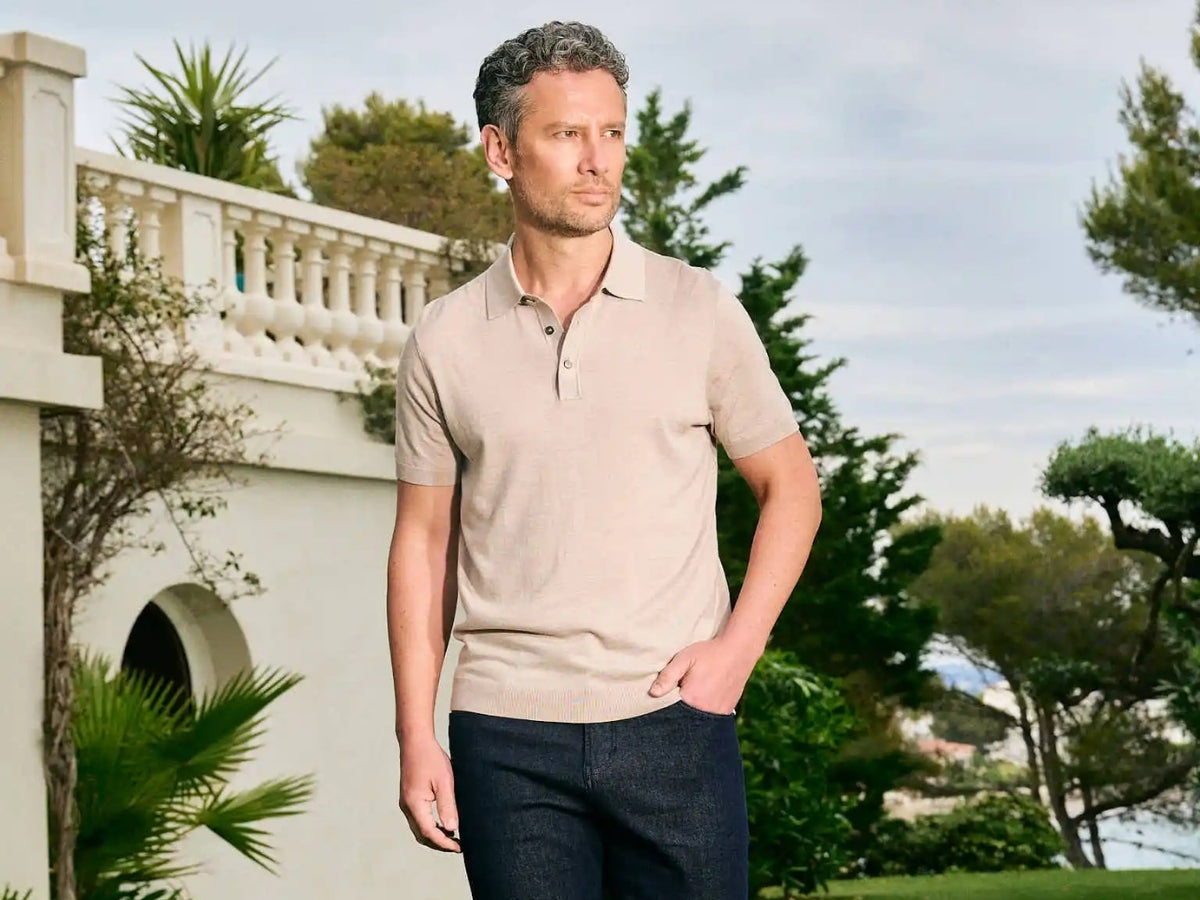
Men's Polo Shirt Guide: Fabrics, Fit and Styling
Almost every man owns a polo. Far fewer own one that looks the way it did in the shop. The collar goes soft, the hem creeps upward after a few washes, and what started as a considered piece slowly turns into something you wear to mow the lawn. That decline is not inevitable. It comes down to a handful of decisions made at the point of buying, most of which are easy to check if you know where to look.
What follows is what actually separates a polo you keep for five years from one you replace every summer.
Start with the collar, not the fabric
Most guides open with fabric. In practice the collar tells you more, and it tells you faster. Pick the shirt up and let the collar sit in your hand. A well made one holds its shape without you doing anything. It has a slight roll to it and stands away from the body of the shirt rather than lying flat against it.
That structure comes from how the collar is knitted and finished. Better polos use a separately knitted collar with a denser gauge than the body, sometimes with a light interlining. Cheaper ones cut the collar from the same fabric as the shirt and rely on nothing but the seam to hold it up, which works for about a month.
The reason this matters more than anything else is that the collar is the part people look at. It frames your face and it sits at eye level in every conversation you have. A shirt can fit beautifully everywhere else and still look wrong if the collar has given up.
Check the placket while you are there. It should lie flat and closed without gaping, and the buttons should sit in reinforced holes rather than raw ones. Loose buttons on a polo are almost always a sign of the rest of the construction.
The knit decides how it behaves
A polo is knitted rather than woven, which is the whole reason it occupies the space it does. Woven cloth holds a line and creases sharply. Knitted cloth stretches, drapes and moves. That is why a polo reads as relaxed even with a collar attached, and why it forgives a warm afternoon in a way a stiff shirt does not. If you want the fuller comparison, we set it out in Polo Shirt vs T-Shirt, and the woven half of the wardrobe is covered in our Men's Shirts Guide.
Piqué is the knit most people picture. It has a fine waffle texture, sits slightly off the skin and moves air well, which is why it has survived a century of warm weather. It also hides the small creases that appear across your front after two hours at a desk. If you only buy one polo, buy this one.
Jersey is flat and smooth, closer to a good T-shirt. It looks cleaner and slides under a jacket without bulk, but it shows every crease and it will cling if the fit is anything less than generous. Jersey rewards a slightly looser cut.
Mercerised cotton is worth understanding because it explains a price difference that otherwise looks arbitrary. The yarn is treated under tension before knitting, which swells and smooths the fibre. You get a quiet sheen, deeper colour that survives washing, and noticeably more resistance to the stretching that ruins collars and hems. Our Mercerized Short Sleeve uses Egyptian SUPIMA cotton for exactly that reason, and the difference is obvious after ten washes rather than on day one.
Then there are the blends. A small percentage of silk changes how a polo falls, giving it a fluid drape that suits evening wear and warm climates. The Horizon Polo works this way. Technical fabrics go in the opposite direction, trading softness for shape retention and quick drying, which earns its place on a long travel day more than at a dinner table. If fabric behaviour interests you generally, Best Fabrics for Men's Shirts and Polyester vs Cotton go further into it.
Fit is decided at the shoulder
Everything else about polo fit is negotiable. The shoulder is not. The seam needs to land on the outer edge of your shoulder bone, and if it sits past that point the entire shirt hangs off you and no amount of tailoring elsewhere fixes it. Try it on and look at the seam before you look at anything else.
Through the chest you want the fabric to skim you. Knitted cloth stretches, so a polo that feels fine standing still can pull open at the placket the moment you sit down or reach for something. If you see horizontal tension lines across the chest, that is your answer.
Sleeves should finish around mid bicep and circle the arm with a small amount of air. Shorter than that and it reads sporty, longer and it starts to look like it belongs to someone else. This is the measurement most men get wrong, usually because they bought a size up to be comfortable and the sleeve came down with it.
Length is simpler than people assume. The hem should end somewhere around the middle of your fly. That gives you enough fabric to tuck if you want to, and short enough to leave out without covering your pockets. Anything longer was cut to be tucked, whatever the label says. The same logic applied to woven shirts is in How a Shirt Should Fit.
Colour does more work than you think
Polos live or die on colour more than most garments, because there is no pattern or structure to carry them. Muted, slightly complex tones tend to look considerably more expensive than flat primaries. Olive, stone, navy, deep brown and off white all sit well against most skin tones and pair with the trousers you already own.
Black is the one to approach carefully. It goes dusty and grey faster than any other colour in a cotton knit, and it flattens the texture that makes a piqué interesting in the first place. If you want dark, a deep navy or a charcoal usually holds up better.
Wearing it without looking like a uniform
Tucked into tailored trousers with a belt and clean footwear, a polo covers most business casual situations without argument. That combination fails in only two ways: when the polo is too big, or when it carries sporty details like contrast piping and large logos. Keep both under control and it holds up in any room that is not explicitly formal.
Untucked with chinos, linen trousers or tailored shorts, it does everything a T-shirt does with more intent behind it. Texture matters more here than colour. A piqué or a slubbed knit in a natural tone reads deliberate even when the rest of the outfit is relaxed. There are more combinations along these lines in Summer Outfit Ideas for Men.
For evening, reach for the softer fabrics. A cotton and silk polo in a deeper tone with dark trousers works in warm weather where a shirt would feel like too much. Leave one button open at most. Three open buttons is a decision, and rarely the right one.
Layering is where the polo quietly beats the T-shirt. Under a crew neck jumper the collar gives the neckline somewhere to resolve, and the outfit stops looking flat. Under an unstructured jacket or a bodywarmer it does the same job. Pieces from our knitwear collection work well over a polo once the temperature drops.
Keeping it alive
Two habits do most of the work. Fold your polos instead of hanging them, because knitted shoulders stretch over a hanger and never quite recover. And leave the collar alone with an iron. It is meant to have a slight roll, and pressing it flat removes the only structure it has.
Wash cold, skip the dryer, dry flat. Cotton polos lose a little length on the first wash regardless, but heat is what turns that into a real problem.
What to actually own
Three covers nearly everything. One neutral piqué for daily wear, one in a refined finish such as mercerised cotton for occasions where you want to look like you tried, and one in a blend or technical fabric for travel and heat. Keep them within one colour family so they share the same trousers and shoes, and you have effectively bought a lot more than three outfits.
You can see the full range in our polos and tees collection, or look through Essentials if you are building from the ground up.